.png)
The Most Powerful Competitive Advantage in Your Market Has Nothing to Do With Technology
Something is shifting in sales and leadership conversations right now.
Not in the market data. Not in the economic indicators or industry reports. In the conversations themselves.
Over the past several months I have been talking with producing agents, team leaders, mortgage professionals, financial advisors, and sales leaders across multiple industries about what they are noticing. And the same thing keeps coming up, almost word for word, regardless of industry or experience level.
Their clients know when they are not talking to a real person. And they do not like it.
One sales professional put it this way: "I can tell immediately when I reach out to a company and get a bot response. I know right away. And I think less of them for it. Why would my clients feel any differently about me?"
She is right. They do not.
What Happened to the Conversation
The past decade in sales was largely optimized for speed and scale. Automation. Drip sequences. AI-generated follow-up. Systems designed to reach more people with less effort.
And for a while, it worked.
But something happened that no algorithm predicted. Buyers got numb. They have seen every variation of the automated sequence too many times to feel anything when it arrives in their inbox. They recognize the pattern. They know no one is actually thinking about them on the other end of that message.
Ryan Levesque, whose work I have been following closely, describes this shift in terms of neurochemistry. The old playbook, he argues, was optimized for dopamine. Urgency. Scarcity. The notification that demands immediate attention. Dopamine tactics worked until they became so cheap and so replicable that they lost their power entirely.
What he calls the next edge is oxytocin. The neurochemical of trust, connection, and genuine human bonding.
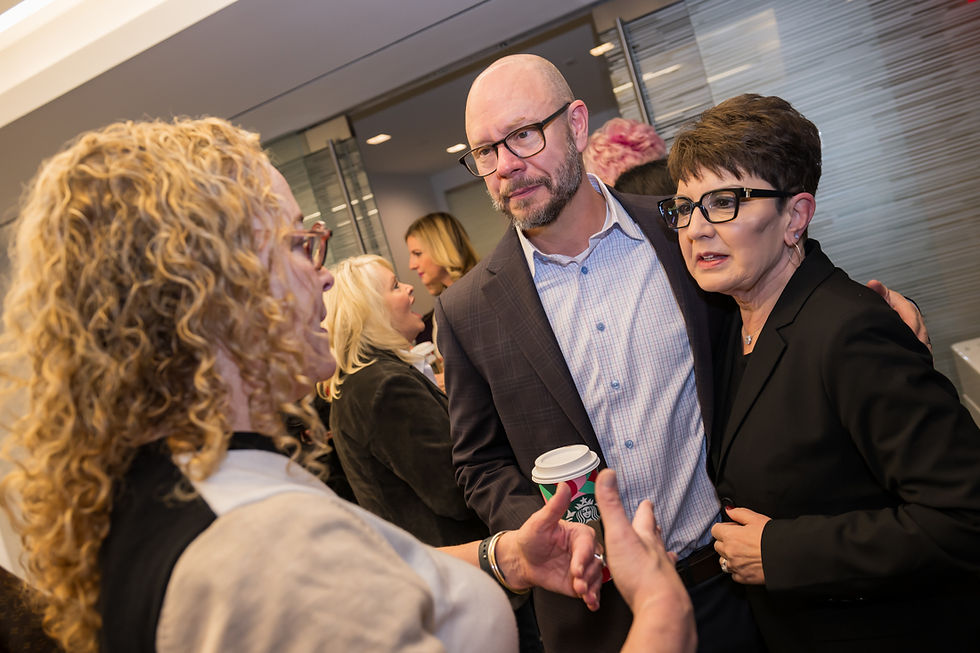
In sales and leadership terms, that means presence. It means a real voice on the phone. It means a face across a table. It means a follow-up message that proves someone was actually listening.
In a world where everything can be automated, what cannot be automated becomes the most powerful differentiator you have.
What Professionals Across Industries Are Telling Me
The professionals I coach are not anti-technology. They use it, and they use it well. But the ones building the strongest pipelines and the most loyal client bases right now are doing something the technology cannot replicate.
They are showing up as humans.
They are picking up the phone instead of sending a text. They are scheduling a coffee conversation instead of a Zoom call. They are writing a personal note instead of triggering a sequence.
A mortgage professional I work with recently shared that her referral business doubled in one quarter after she committed to five genuine voice-to-voice conversations every single day. Not automated touchpoints. Not email sequences. Real conversations with real people about what they were navigating.
Her pipeline did not grow because she had better technology than her competitors. It grew because she had better conversations.
That is not a real estate story. That is a human story. And it plays out the same way in financial services, insurance, coaching, and every other relationship-driven business where trust is the product.
The Real Cost of Fake Connection
There is a cost to automation that does not show up in your CRM metrics.
When a client receives a bot response to an emotional question about a major financial decision in their life, something breaks quietly in the relationship. They may not say anything. They may not disengage immediately. But they begin looking for a professional who feels real.
And in a referral-driven business, that quiet erosion is more dangerous than any market shift.
Adam Mosseri, the head of Instagram, made an observation he posted on 12/31/2025 that I have been thinking about ever since I read it: in a world where everything can be perfected, imperfection becomes a signal.
What he means is that authenticity, the kind that only comes from a real person in a real moment, is becoming increasingly rare. And rare things become increasingly valuable.
Your voice is rare. Your presence is rare. Your genuine curiosity about the person sitting across from you is something no AI will ever replicate.
Face to Face. Voice to Voice. Now More Than Ever.
I want to be direct about something.
The sales professionals and leaders who will build the most durable businesses over the next decade are not going to be the ones with the most sophisticated automation stack. They are going to be the ones who master the human conversation.
The face-to-face conversation when a client is making a decision that affects their family's financial future.
The voice-to-voice call that follows up when silence has set in after a meaningful meeting.
The first interaction with a prospect that begins not with a pitch but with a genuinely curious question about where they are and what they are trying to figure out.
These are not old-fashioned approaches. They are competitive advantages. And in a market saturated with AI-generated content and automated touchpoints, they are becoming more powerful, not less.
The technology will keep improving. The bots will get more convincing. The sequences will get more sophisticated.
And the professionals who pick up the phone and say something real will keep winning.
Because trust has always been built the same way. One genuine conversation at a time.
Chris Ruszkiewicz is an Exactly What to Say® Certified Guide and the founder of CMR Coaching & Consulting, a founding owner of a Keller Williams Realty office, and an Executive Business Coach with 32 years of experience in sales, negotiation, and leadership.


Comments